If you run a winery, you are not only in the bottle business anymore. You are in the memory business.
The next valuable guest is the mindful drinker: they drink less, spend intentionally, and reward places that feel restorative.
This article is built like a magazine read: clear narrative, real numbers, practical steps, and one direct path to execution.
KEY POINTS
Mindful drinkers choose quality of experience over quantity of pours.
Wellness tourism demand is growing, and wineries are naturally positioned to serve it.
A full-day rhythm outperforms a rushed tasting flight.
Simple food and slower pacing increase memory and perceived value.
The paid report translates this into pricing, operations, and a 90-day rollout.
SECTION 01
A new buyer behavior is already here
A new kind of wine day is replacing the old rush.The buyer is calmer, slower, and more selective.
Less quantity. More intention. Higher memory value.
The old tasting-room logic was volume: more pours, more stops, more throughput. That still works for some guests, but it no longer describes the whole opportunity.
The new logic is experience density: fewer pours, better framing, deeper story, a stronger emotional memory. A guest does not need to be a serious wine collector to value an exceptional wine-country day.
For an owner, the opportunity is to stop building one standard visit for everybody. Build a small number of clear experiences for different reasons people leave home.
SECTION 02
The mindful drinker profile
They drink better, not more.
Mindful drinkers are not necessarily anti-alcohol or anti-celebration. They are anti-rush and anti-generic. Their visit must feel good before the first glass arrives.
They notice the whole experience stack: how easy it was to book, whether the welcome is personal, where they sit, what they eat, how the host tells the story, and whether they can slow down without feeling in the way.
This is a useful distinction. You do not need to market to a vague wellness audience. You need to make the estate more relevant to people who already value nature, food, movement, connection, and moderation.
BEHAVIOR
Drinks fewer glasses
They value clarity and memory over volume and speed.
MOTIVATION
Seeks meaningful downtime
They use wine moments as part of emotional and social reset.
SPENDING
Pays for thoughtful structure
They spend more easily when curation is visible and coherent.
LOYALTY
Returns to felt experiences
They remember pace, host quality, and setting as much as the bottle.
SECTION 03
One estate. More than one guest.
The answer is not more events. It is clearer reasons to visit.
A winery does not have one visitor. It has a portfolio of visitors with different motivations, confidence levels, schedules, and reasons for spending.
Wine tourism research consistently identifies learning, purchasing, meeting the producer, landscape, and group activity as important but distinct visit motivations. The offer should make the guest feel recognised before they arrive.
Start with two audience-led formats, not six. A small estate may choose a focused wine-learning visit and one slow food-and-landscape visit. A larger estate can add private celebrations or membership programming later.
01 · THE LEARNER
Wants confidence
Offer a focused vineyard-and-cellar lesson, then a short tasting with language they can use at home.
02 · THE FOOD TRAVELER
Wants local taste
Build one seasonal table around regional produce, one grower, and wines that make the meal clearer.
03 · THE MINDFUL GUEST
Wants to reset
Create a slow morning or afternoon: landscape, light movement, a few wines, then a calm finish.
04 · THE CELEBRATION
Wants an occasion
Sell a private table, a sunset moment, a personal host, and one ritual worth photographing and remembering.
05 · THE LOCAL REGULAR
Wants belonging
Give locals a recurring reason to return: seasonal lunches, walking clubs, harvest access, or member evenings.
06 · THE NON-DRINKER
Wants inclusion
Provide a serious adult alternative, a food pairing, and the same quality of hosting. Do not make them an afterthought.
SECTION 04
Why now: the demand signal is measurable
Wellness travel is now mainstream demand, not niche demand.
1.24B
Wellness trips taken globally in 2024.
SOURCE: GLOBAL WELLNESS INSTITUTE, 2025 MONITOR
WELLNESS TRAVEL'S SHARE OF GLOBAL TOURISM · 2024
ALL TOURISM TRIPS8.3%
ALL TOURISM SPENDING17.6%
SOURCE: GLOBAL WELLNESS INSTITUTE, 2025 MONITOR
When tourism behavior changes, tasting-room economics change with it.
The Global Wellness Institute recorded $893.9 billion in wellness-tourism spending in 2024. It also counted 1.239 billion wellness trips, representing 8.3% of all tourism trips but 17.6% of tourism spending. The lesson: this is a high-value traveler, not a niche guest to be ignored.
Not all of these visitors book a retreat. GWI distinguishes between primary wellness travelers, who choose a trip for wellness, and secondary wellness travelers, who simply want to keep their healthy routines while away. The secondary group is the practical opportunity for a winery.
A winery already has elements they seek: landscape, fresh food, outdoor activity, a sense of place, and an opportunity to switch off. You do not need to become a spa. You need to make those strengths easy to discover and easy to book.
SECTION 05
Wine industry pressure makes this urgent
US WINE INDUSTRY TOTALS (SVB)
VOLUME 2024335.9M cases
VOLUME 2025329.0M cases
VALUE 2024$75.5B
VALUE 2025$74.3B
SOURCE: SVB 2026 STATE OF THE US WINE INDUSTRY
OLD OPERATING ASSUMPTION
Demand will normalize soon, and traffic will recover by itself.
2026 MARKET REALITY
SVB reports an ongoing demand correction, with declining tasting-room visits and smaller checks at many small, DTC-focused wineries. Waiting is now a strategy risk.
SVB's 2026 report estimates U.S. wine volume fell from 335.9 million cases in 2024 to roughly 329 million in 2025, while industry value moved from $75.5 billion to $74.3 billion. Smaller hospitality-led wineries also reported softer visits and average check sizes.
But the market is not moving as one. SVB's 2026 DTC research found its top-quartile wineries grew revenue 22%, while the median was flat and the bottom quartile declined 13%. The strongest operators did not simply cut costs: they invested in customer relationships.
The report identifies appointment-led tastings, member exclusives, food-paired experiences, trained hospitality teams, and personalization as common traits among the best performers. Make the visit feel chosen for the guest, not pushed through a script.
SECTION 06
Design the day, not only the tasting
Movement before tasting changes attention quality.
Your premium is not only in the bottle. It is in the sequence.
Many wineries still sell tastings as isolated transactions. A stronger model is a sequence with a beginning, middle, and close: arrive, move, taste, eat, pause, then leave with one clear memory.
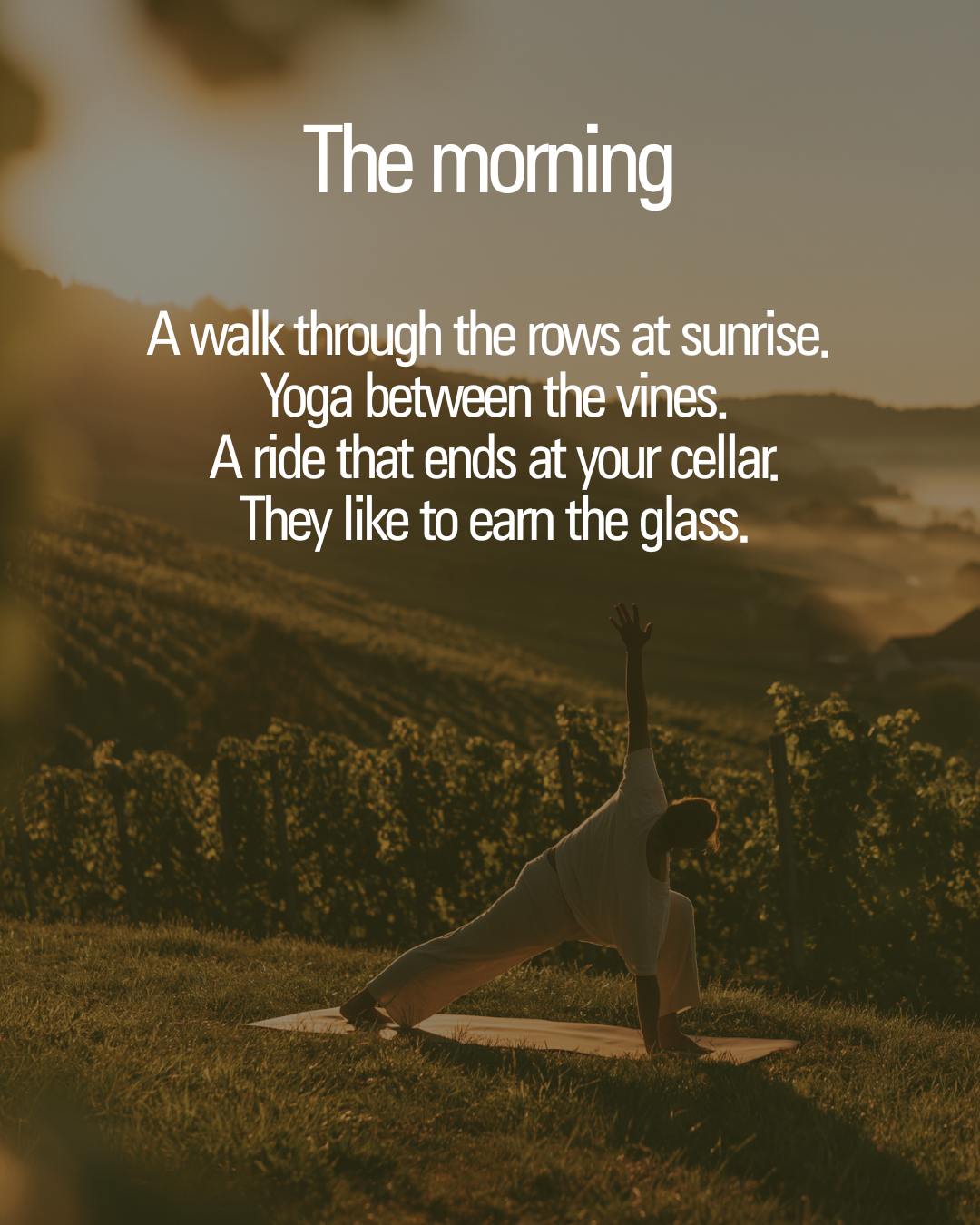
The format can be light. A vineyard walk, a five-minute stretch, a guided nature route, or a simple ritual before tasting is enough to change the pace. The point is not wellness theatre. The point is creating attention.
Make the wine the destination of the sequence. The exercise, food, and landscape should frame the bottle and the place—not distract from them.
PHASE 01
Arrival + exhale
Five-minute welcome ritual, hydration, and expectation setting.
PHASE 02
Movement + landscape
Guided walk, light activity, or vineyard stretch before first pour.
Simple food and slower pacing to let the wines open and settle.
APPLY IT — THIS WEEK
Map your current guest journey in four phases.
Remove one friction point and add one premium ritual this month.
SECTION 07
Food and pace are value multipliers
Simple food can elevate wine perception.Pace and stillness are part of the offer.
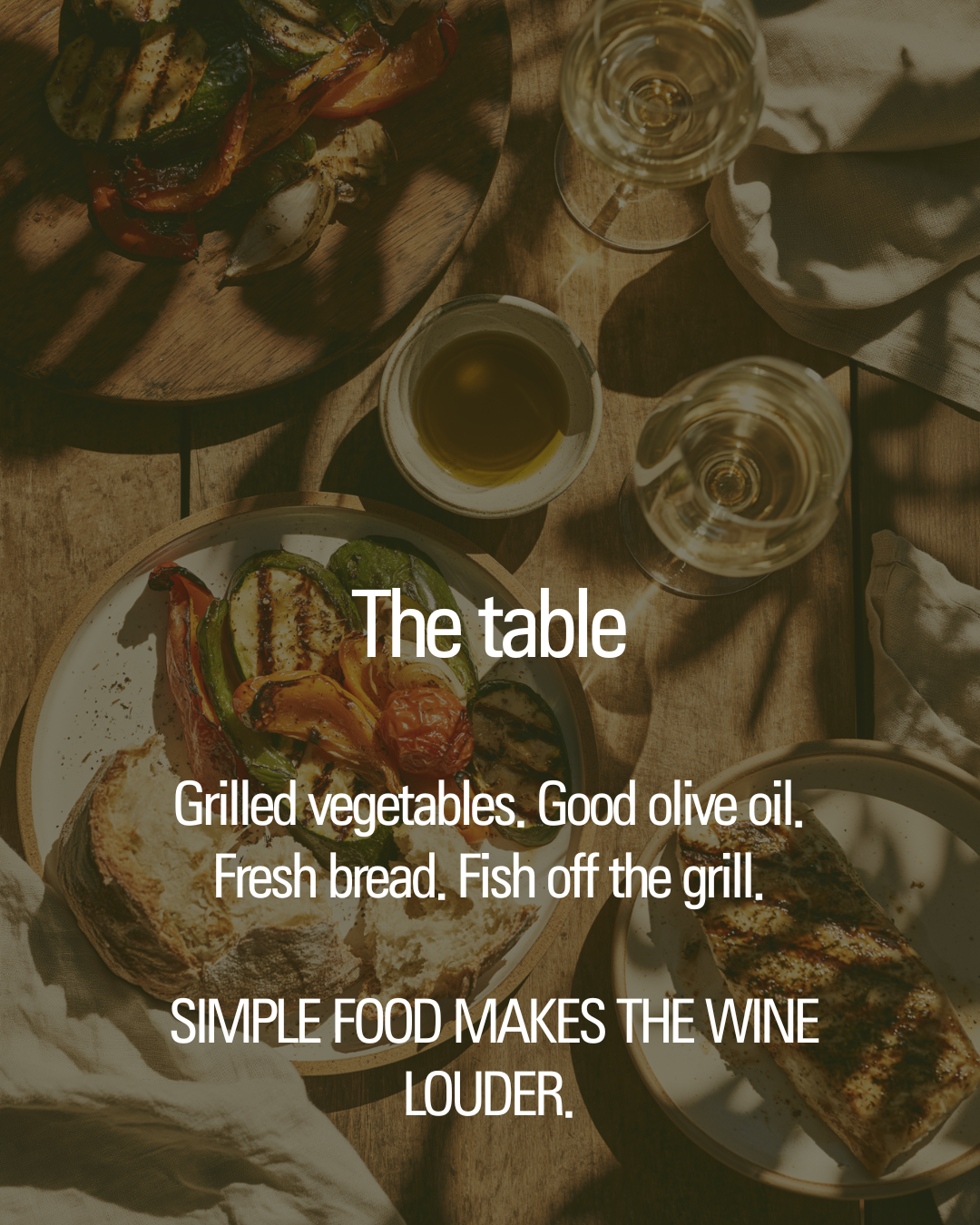
The most memorable pairings are often simple: grilled vegetables, fresh bread, olive oil, one honest fish dish. Complexity is not the same as quality. The food should make the wine more legible, not turn the visit into a difficult restaurant service.
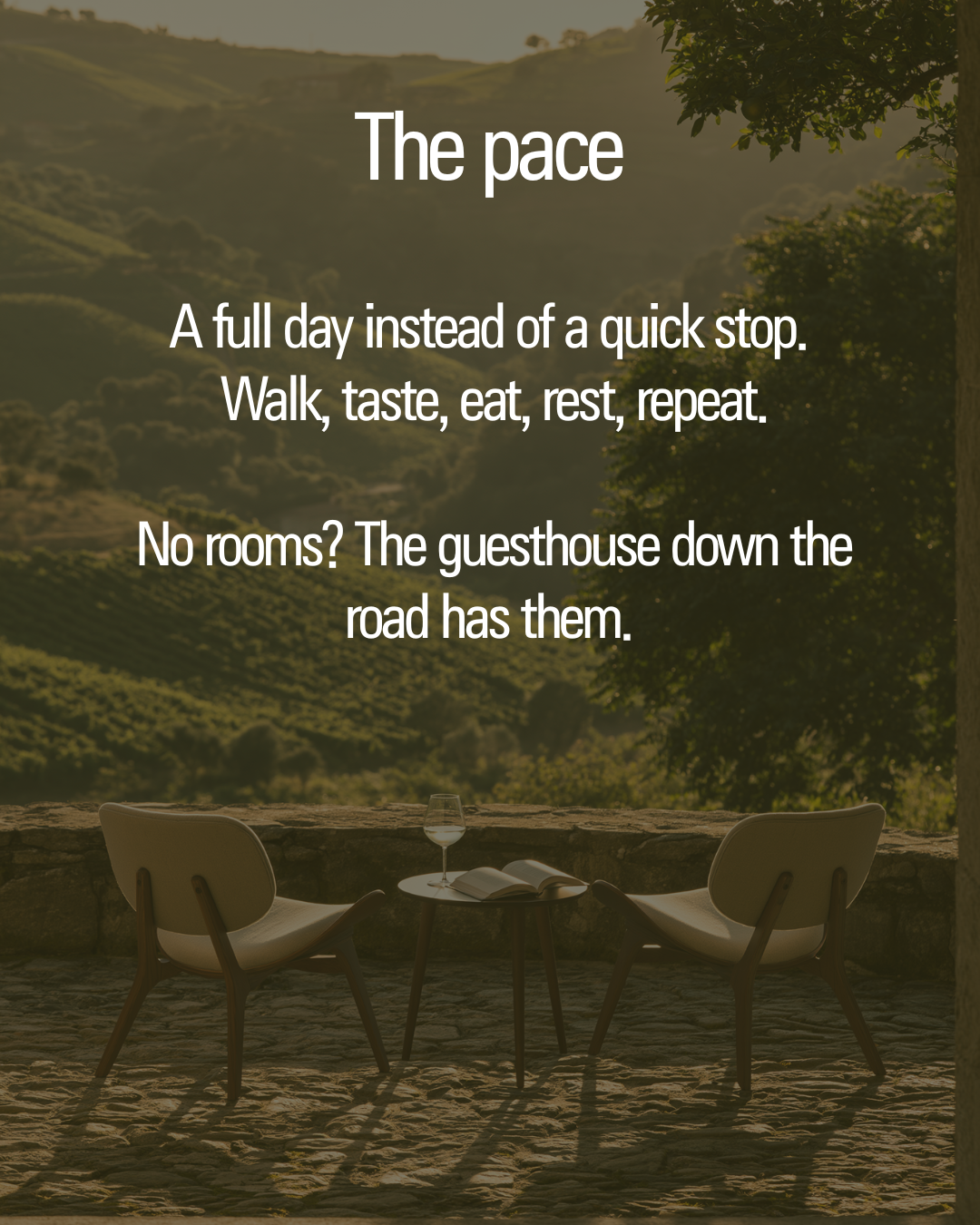
Pace is a design decision. Build real space between arrival, storytelling, tasting, and food. Do not use a 90-minute reservation to force six wines and an estate history into one rush.
WineGB's tourism data provides a useful reminder: wineries are now offering a much broader set of visits, including tours, places to eat, stays, self-guided routes, picnics, events, and local partnerships. The point is choice with a clear point of view—not an endless activity list.
SECTION 08
No rooms? Build the partnership model
You do not need on-site accommodation to compete. You need one clean partner workflow with a nearby guesthouse, a local driver, a chef, guide, or movement instructor. WineGB's visitor model is full of this kind of ecosystem thinking: trails, cafés, restaurants, stays, and vineyard experiences make a region easier to visit.
Package the day as one product where possible. One landing page, one itinerary, one clear meeting point, transparent inclusions, and shared service standards. If booking must happen separately, make the handoff feel deliberate—not accidental.
Start with partners who already share your guest: a design-led guesthouse, a local food producer, a cycling guide, or a wellbeing professional with a mature client base. Their audience is more valuable than random reach.
APPLY IT — THIS WEEK
Select two local partners and design one fixed-date pilot.
Write the itinerary, inclusions, capacity, price, and rain plan on one page before you market it.
SECTION 09
What winery owners should measure
If you want this strategy to stay real, you need operator metrics, not vanity metrics. The number of likes on an event post will not tell you whether the format works.
Track average check by experience, booking lead time, show rate, dwell time, bottle conversion, club inquiry, rebooking intent, and whether guests came through a partner. Review those figures after every pilot, not only at the end of the season.
Set a small test: two dates, one clearly defined audience, 12 to 20 guests, and one success threshold. Within 60 to 90 days, you will have enough evidence to refine, repeat, or stop.
COMMERCIAL
Average check by experience type
Track spend difference between classic tasting and wellness-day formats.
BEHAVIOR
Dwell time
Longer intentional stays generally correlate with stronger memory and spend.
RETENTION
30-day repeat intent
Capture rebooking, club inquiry, and return probability after visit.
STORY
Guest language quality
Review comments for emotional words and detail depth, not only star count.
SECTION 10
One glass they remember
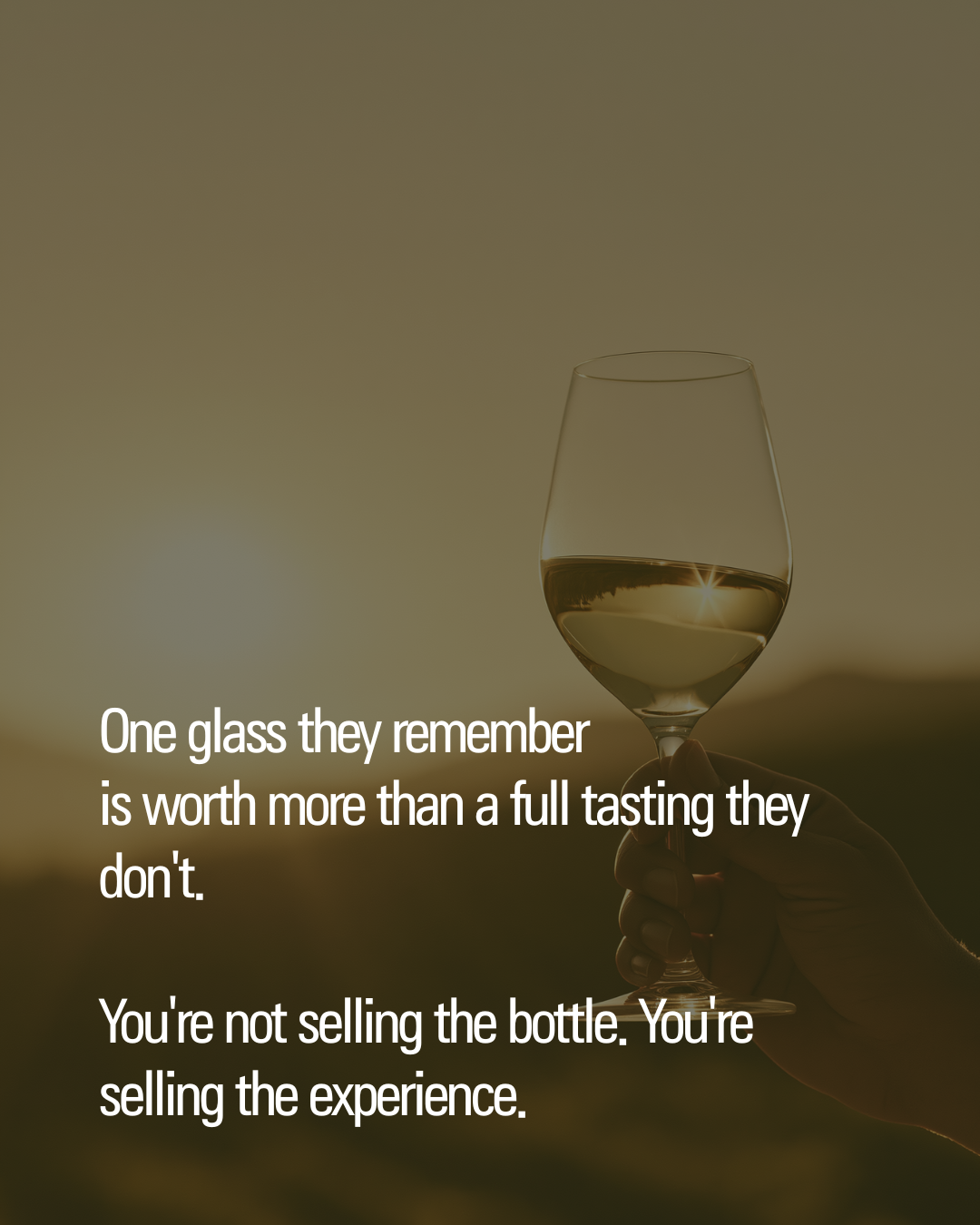
You're not selling the bottle. You're selling the experience.
One glass they remember is worth more than a full tasting they don't.
The work is not to persuade every guest to buy more. It is to make the right guest feel that the bottle belongs in their life after they leave.
That is where hospitality becomes a retention system. A thoughtful visit creates the story that supports a future order, club decision, referral, or return trip.
The bottle is still the hero. The day is the frame that helps the guest understand why it matters.
SECTION 11
You have the place
We have the wine consumer data. You have the place.
If you run a winery, a hotel, or a wellness hospitality retreat — let's build this together.
The public article gives the strategic frame. The paid report gives the operator blueprint.
In the report, you get offer architecture, pricing logic, staffing model, partnership templates, and a 90-day rollout plan.
Read the report preview, register your free account, and unlock the full edition at /books/winery-edition.
NEXT STEP
Want the full report?
Continue with The Wellness Winery Report for pricing, operations, and a 90-day rollout plan.